
Why settle for "good enough" when you can achieve retail perfection? Most printers treat a heavy fleece like a standard t-shirt, but that is a mistake that leads to peeling and cracking. A thick hoodie requires a high-performance bond specifically calibrated for its unique texture. If you want your designs to stay vibrant and survive the wash, you must master the art of applying DTF transfers for hoodies.
You likely realize that thick fabric and bulky pockets make alignment a total nightmare. We agree that nothing ruins a brand's reputation faster than a crooked or peeling print. This guide promises to turn you into an application expert. You will learn the pro-level techniques to ensure every print is stretchy, durable, and full of vibrant colour. We are going to dive into professional heat press settings, pocket alignment hacks, and how to work with a local Edmonton-area printing partner to scale your business with confidence.
Key Takeaways
- Master the high-performance bond required to fuse designs into heavy fleece for a retail-ready, professional finish.
- Navigate the technical differences between brushed fleece and French terry to choose the ideal substrate for maximum print durability.
- Implement a critical pre-press routine to eliminate moisture and ensure DTF transfers for hoodies adhere perfectly to thick fibres.
- Eliminate common production headaches like scorching and peeling with expert-led troubleshooting for heat settings and seam alignment.
- Boost your profit margins and accelerate production by leveraging cost-effective gang sheets and local Edmonton-area printing expertise.
Why DTF Transfers for Hoodies Outperform Traditional Methods
Hoodies are the heavyweights of the apparel world. They are thick, textured, and often feature a high-pile fleece that makes standard printing methods struggle. If you have ever tried applying thin vinyl to a chunky fleece, you know the frustration. It looks great for an hour, then starts to lift at the edges. DTF transfers for hoodies solve this by creating a high-performance bond that traditional heat transfer vinyl (HTV) simply cannot match. Instead of sitting on the surface, the adhesive becomes part of the garment.
Vibrancy is another major win. Maintaining a crisp, bright white on a charcoal or navy hoodie is notoriously difficult. Many methods suffer from dye migration, where the fabric's colour bleeds into the print. The Direct-to-Film (DTF) printing process uses a dense white ink underbase that acts as a literal shield. This ensures your colours pop with retail-quality intensity, regardless of the garment's base shade. Plus, the finished print is incredibly stretchy. It moves with the heavy fabric, resisting the cracking that often ruins screen-printed hoodies after a few trips through the wash.
DTF vs. Screen Printing: The Canadian Brand Perspective
For Alberta entrepreneurs, efficiency is everything. Screen printing is fantastic for massive runs, but it is a logistical nightmare for small batches or complex, multi-colour art. DTF eliminates the need for expensive screens and long setup times. It is the most cost-effective way to launch a premium hoodie line with intricate details. Durability is also a non-negotiable factor in the Great White North. These prints are tested to survive the Edmonton cold. They won't become brittle or flake off when the mercury drops. Explore the full breakdown of DTF vs screen printing to see which fits your production scale.
The Science of the Adhesive Bond
The magic happens with TPU (Thermoplastic Polyurethane) powder. This isn't just glue; it is a specialized resin that penetrates deep into the fleece fibres during the heat press cycle. This creates a permanent lock that is virtually impossible to peel. The white ink base doesn't just provide colour; it provides the structural integrity needed for a soft feel finish. You get a print that feels like part of the shirt, not a heavy plastic shield. This professional-grade result is why local brands are switching to DTF transfers for hoodies to elevate their merch game and deliver products that last.
Selecting the Right Hoodie Materials for DTF Transfers
Selecting the right fabric is just as critical as the print itself. You cannot treat a 400GSM heavy-weight fleece the same as a lightweight summer blend. Success with DTF transfers for hoodies starts at the fibre level. While 100% cotton remains the gold standard for ink absorption, the reality of the Canadian market involves a lot of polyester blends. These blends offer the warmth we need but require a tactical approach to avoid dye migration or fabric scorching. You want a bond that survives the Alberta winter without losing its visual punch.
When working with heavy garments, heat retention is your biggest enemy. A thick 400GSM hoodie acts like a thermal sponge. It holds heat long after you lift the press, which can lead to over-curing the adhesive or damaging the fabric. If you are dealing with dark or neon fabrics, you must ensure your transfer has a high-opacity blocker to keep those colours from bleeding through the design. Precision matters here. You must match your heat settings to the specific blend to ensure a permanent, retail-ready finish that won't crack or peel.
Brushed Fleece: The Standard Hoodie Challenge
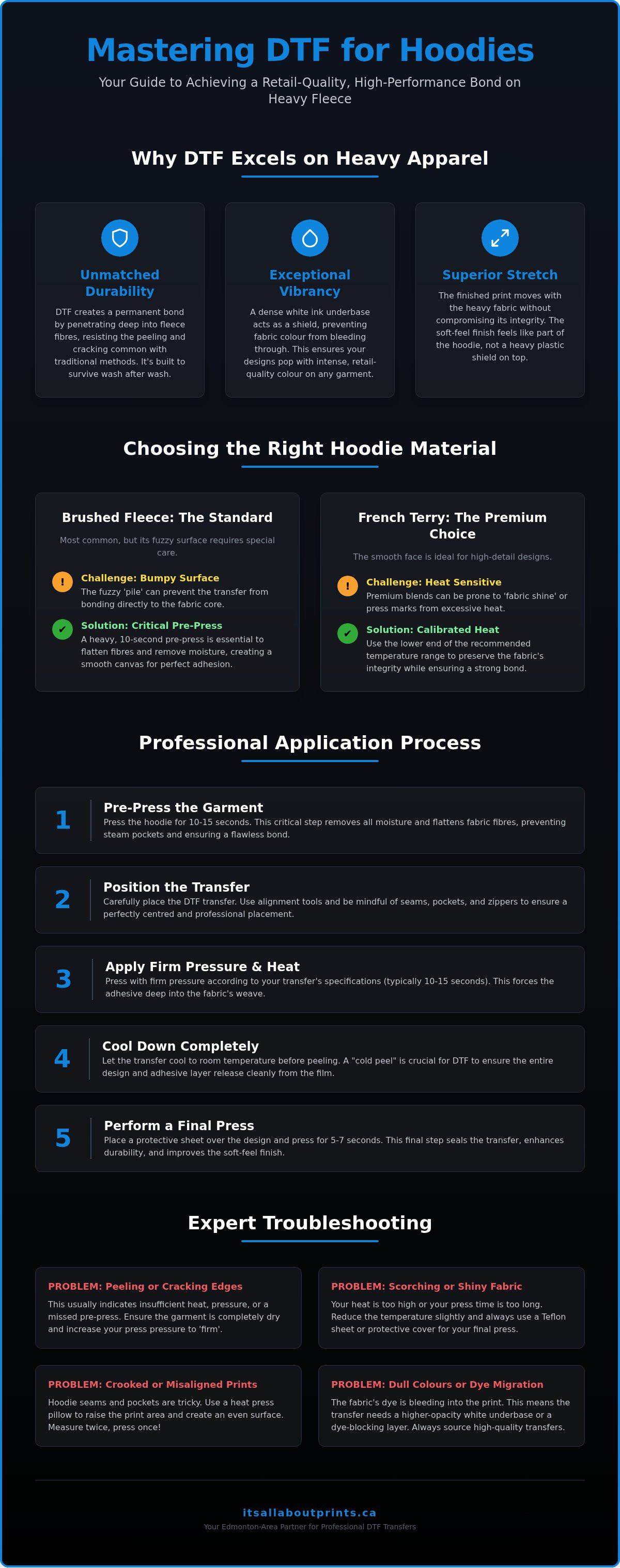
Brushed fleece is the most common hoodie material, but its fuzzy 'pile' creates a bumpy surface. You must use a heavy pre-press to flatten these fibres before applying your design. If you don't, the transfer sits on top of the fuzz rather than bonding to the fabric core. Increase your pressure settings to 'firm' to force the TPU powder into the weave. This prevents the 'ghosting' effect often seen on high-polyester blends where the fabric texture shows through the print. A 10-second pre-press is usually enough to create the flat canvas you need.
French Terry and Premium Blends
French Terry is the hidden gem for high-detail work. Its smooth, flat face allows DTF transfers for hoodies to capture every fine line and gradient without interference from fabric texture. However, these premium blends are often sensitive to high heat. You must calibrate your temperature to the lower end of the recommended range to prevent 'fabric shine' or permanent press marks. For oversized silhouettes, always scale your artwork to match the garment's proportions. A small chest print looks lost on a 2XL boxy fit. If you are looking to elevate your brand with retail-quality results, you can order custom DTF prints designed specifically for these high-performance materials.
Step-by-Step: How to Apply DTF Transfers to Hoodies
Applying DTF transfers for hoodies is a game of physics. You are fighting thick seams, moisture-trapping fleece, and bulky pockets. A standard t-shirt workflow will fail here. To achieve a retail-ready bond, you need a professional process that accounts for the unique anatomy of a heavy-weight garment. Start with the right gear. A high-pressure swing-away or drawer-style heat press is ideal. These machines provide the vertical force needed to crush through thick fabric layers that a basic clamshell might miss.
The pre-press is your most critical step. Do not skip it. Press your hoodie for 10 full seconds at 320°F (160°C) before even touching your transfer. This serves two vital purposes. It evaporates hidden moisture deep within the fleece and flattens the high-pile fibres. If you skip this, the steam generated during the main press will push the adhesive away, leading to premature peeling. Once the surface is flat and bone-dry, you are ready for the 'Golden Trio' of application: 320°F, 15 seconds, and firm pressure.
Precision Placement: Navigating Pockets and Hoods
Alignment is where most beginners struggle. For a standard chest print, follow the 3-finger rule. Place the top of your design three fingers below the collar seam. This keeps the graphic centered on the chest rather than sagging toward the belly. Kangaroo pockets create a massive height difference that can ruin your pressure. Use a heat pillow. Slide it inside the hoodie to raise the print area above the pocket seams. This ensures the heating platen hits the transfer evenly. For back designs, drop the placement 5 to 7 inches from the collar. This prevents the hood from covering your brand's artwork when it is worn down.
The Finishing Press: Locking in the Texture
The peel is just the beginning. Whether you are using a hot or cold peel film, the finishing press is what guarantees longevity. After removing the carrier sheet, cover the design with parchment paper and press again for 5 to 8 seconds. This second hit drives the TPU adhesive deeper into the fabric weave. It also allows you to control the final look. Parchment paper delivers a professional matte finish, while a Teflon sheet provides a slight gloss. Finish by performing a gentle stretch test. The print should move fluidly with the fabric. If it resists or cracks, your pressure was too light. Mastering DTF transfers for hoodies means ensuring that the design is as durable as the garment itself.
Troubleshooting Common Hoodie Printing Issues
Mistakes happen. Even seasoned pros face the occasional setback when applying DTF transfers for hoodies. The key is knowing how to diagnose the issue before it ruins an entire production run. Scorching is a frequent headache, especially on light-coloured or pastel hoodies. If you see yellowing or a permanent press mark, your temperature is too high or your dwell time is too long. Protect delicate fabrics by using a Teflon sheet and dropping your heat by 10 degrees while slightly increasing the press time.
Peeling usually occurs near the high-stress areas like the kangaroo pocket or shoulder seams. If the transfer lifts, it is almost always a pressure problem. The bulk of the seam prevents the heat platen from making full contact with the design. This leaves the adhesive uncured. Dye migration is another silent killer. This happens when the polyester dyes in the fabric gas out and bleed into your white ink. Ensure you are using high-opacity transfers with a dedicated blocker layer to keep your whites crisp and clean. If you see "silvering" or tiny air bubbles trapped under the film, increase your pressure. You need to force the air out to create a seamless, liquid-like bond.
Wash and Care for Longevity
Your job isn't done once the press opens. You must educate your customers to protect your hard work. DTF durability is legendary, but it requires a 24-hour curing period before the first wash. Tell your clients to wash garments inside-out in cold water. They should avoid the tumble dryer whenever possible. High heat in the dryer can eventually soften the adhesive bond over years of use. Providing these simple instructions ensures your brand reputation remains spotless among local Edmonton designers who value quality that survives the Canadian wash cycle.
Fixing Misaligned Prints
Can you save a hoodie with a crooked print? The short answer is usually no. Once the TPU powder is fully cured into the fleece, it is a permanent part of the garment. This is why preparation is everything. Use laser guides or physical alignment templates for bulk production to ensure every piece is identical. If you are still learning the ropes and want to understand the technical side of the hardware, check out our guide on What is DTF? to see how the technology works. Accuracy is the hallmark of a professional. If you want to avoid these common pitfalls from the start, you can get professional-grade transfers that are engineered for easy, error-free application.
Scale Your Brand with Bulk DTF Transfers in Edmonton
Scaling a clothing line requires a supply chain that responds in real-time. While international shipping introduces delays and customs headaches, local production in Alberta keeps your inventory fluid and your brand responsive. Using gang sheets allows you to maximize your budget by fitting multiple designs or size variations onto a single roll. This makes DTF transfers for hoodies the most efficient way to launch a seasonal collection without overextending your capital. You get the benefit of high-volume pricing without the risk of long-distance logistics.
We are committed to supporting the local Alberta maker community from Leduc to St. Albert. Partnering with Its All About Prints limited gives you access to professional graphic design and the technical expertise needed to scale with confidence. We act as your high-capacity production engine, providing the reliability you need to fulfill bulk orders for corporate clients or local festivals. Our team takes personal pride in being the "behind-the-scenes" force that allows Edmonton-area entrepreneurs to shine.
Ordering Made Simple
File preparation is the foundation of pro-grade output. We require 300 DPI PNG files with transparent backgrounds to ensure your DTF transfers for hoodies are sharp, vibrant, and free of jagged edges. Our turnaround times for the Edmonton, Beaumont, and Nisku regions are built for fast-paced growth. If you have a creative vision but need help with the technical execution, our custom design services can turn your rough concepts into ready-to-press files that are optimized for our advanced printing technology.
Beyond Apparel: Creating a Cohesive Brand
A professional brand identity should extend far beyond the garment. By integrating UV DTF for hard goods and custom stickers, you create a unified experience for your customers across all touchpoints. The Its All About Prints limited difference is built on assertive quality and a fearless approach to complex designs. Stop waiting on overseas logistics and order your custom DTF transfers today to see how a dedicated Edmonton partner can accelerate your business growth.
Elevate Your Brand with Retail-Quality Hoodie Prints
Stop settling for mediocre results that peel and crack after a few washes. You now have the technical blueprint to master DTF transfers for hoodies on even the heaviest fleece fabrics. By focusing on the "Golden Trio" of temperature, time, and pressure, you can transform standard blanks into high-performance streetwear. A professional pre-press and finishing press are your best tools for ensuring a permanent, stretchy bond that looks as good as it feels.
Success in the Alberta market requires a partner who understands the local landscape. Our expert printing services are based right here in the Edmonton area, offering high-durability prints specifically tested to survive the Canadian cold. We provide professional graphic design support to ensure your vision is ready for the press from day one. It's time to stop waiting on international shipping and start building your legacy with a reliable local engine.
Ready to dominate? Order your custom DTF transfers for hoodies now!
Your creative journey is just beginning. We are excited to see what you build next.
Frequently Asked Questions
Can I use an iron to apply DTF transfers to hoodies?
No, an iron is not recommended for professional results because it cannot provide the consistent, high pressure required to bond the TPU powder to thick fleece. You need a dedicated heat press to ensure the adhesive penetrates the fabric core. Without this mechanical force, your designs will likely peel or lift after just a few trips through the wash.
What is the best heat press temperature for 100% cotton hoodies?
The optimal temperature for 100% cotton is 320°F (160°C) for 15 seconds with firm pressure. This setting is high enough to melt the adhesive without scorching the natural fibres of the cotton. Always perform a 10-second pre-press first to remove any hidden moisture that could interfere with the bond and cause the print to fail.
Will DTF transfers crack on heavy fleece after washing?
No, high-quality DTF transfers are engineered for maximum stretchability and won't crack if they are applied correctly. The TPU adhesive creates a flexible, liquid-like bond that moves with the heavy fabric during wear and wash cycles. This durability is why DTF transfers for hoodies are the preferred choice for premium Canadian streetwear brands that value longevity.
How do I avoid the hood covering my back design?
Avoid this by placing your back designs at least 5 to 7 inches below the collar seam. This placement ensures the graphic remains fully visible even when the hood is down and resting against the back. Always test the placement on a mannequin or a person to confirm the artwork stays front and centre regardless of how the garment is worn.
Do I need to wash the hoodie before applying the DTF transfer?
You should never pre-wash hoodies before printing because the chemicals in detergents can ruin the adhesive bond. Detergents often leave a microscopic residue on the fibres that prevents the TPU powder from locking into the weave. Stick to a heavy pre-press to flatten the pile and remove moisture, which provides the clean surface you need for a permanent finish.
What is a 'Gang Sheet' and how does it save me money on hoodie prints?
A gang sheet is a printing layout that fits as many designs as possible onto a single roll of film to maximize efficiency. This significantly reduces material waste and lowers your unit cost, often by over 50% compared to buying individual fixed-size transfers. It is the most economical way to scale your production while maintaining the high standards your customers expect.
How long do DTF transfers last on workwear hoodies in Canada?
You can expect professional DTF transfers to last for over 100 wash cycles, even on heavy-duty workwear used in harsh outdoor environments. They are specifically tested to resist fading, cracking, and peeling in extreme cold. This makes them a reliable choice for Alberta businesses that need their branding to stay vibrant and intact throughout the entire winter season.
Can I apply DTF transfers over seams or pockets?
Applying prints over seams or pockets is possible if you use a heat pillow to create a level pressing surface. Without a pillow, the bulk of the seam will lift the heat platen and prevent the pressure from reaching the rest of the transfer. The pillow raises the print area above the obstructions, ensuring an even, high-pressure bond across the entire design.